AI adoption is often described as a decision. A roadmap. A strategy. A moment where an organization chooses to move forward.
But in practice, that's not how much of it shows up. Increasingly, AI arrives quietly, inside tools people already use, changing behavior before anyone pauses to frame it as a choice. The shift doesn't announce itself. It just starts to feel normal.
AI didn't arrive all at once -- it crossed a threshold quietly
Visual search has been around for a long time. Google Lens itself is almost a decade old. What changed wasn't that the technology suddenly appeared, but how much people started using it. In just the last few years, visual searches more than doubled, from roughly 12 billion to 25 billion per month, according to Google internal data.
That growth didn't come from a single announcement or a coordinated push by businesses. It happened because the technology became accurate enough to be useful. Once that happened, behavior shifted quickly. Images stopped being a novelty input and became a normal way for people to search.
For businesses, that shift raised the stakes quietly. Matching images to content now determines whether products show up at all. If images aren't optimized, products don't surface. And if they don't surface, they never enter consideration. Optimizing images isn't something you do to get ahead anymore. It's something you must get right just to be seen.
Visual search gives people a more direct line from what they see to what they want to know, without having to translate that curiosity into text. In both online and real-world settings, people can point a camera at something and get answers immediately. That changes how discovery works and how early intent shows up.
When capability changes behavior, responsibility follows
What's notable is where the work lands. This shift isn't driven by executive mandates or big planning moments. It lands with the people responsible for content creation and optimization. They're now responsible for ensuring images convey the information AI-driven search expects.
That expectation doesn't arrive with much notice. Visual search doesn't wait for debate or alignment. It simply becomes part of how search works. Organizations either support it or quietly fall out of the moment where attention and intent form.
The change here isn't mainly technical. It's behavioral. Search gets faster. Discovery becomes visual. And organizations are expected to keep up.
GenAI in UC follows the same path -- but from inside the enterprise
Unified communications (UC) platforms weren't built for this environment. They were designed to connect people, and for a long time, that was enough. In today's hybrid and faster-moving organizations, communication alone doesn't create much value. It produces a lot of meetings, chats, recordings and shared content that usually goes unused.
The shift doesn't announce itself. It just starts to feel normal.
GenAI doesn't replace UC platforms or radically change how people communicate. It comes in and makes sense of what's already there. Summaries, intent and useful information start to surface without asking people to work differently.
In that context, GenAI in UC isn't really optional. Once it's available, it quickly becomes an expectation. Meetings become more efficient through summaries and transcription. More importantly, communication stops living on its own. It connects more directly to the systems people already use to get work done.
Over time, UC starts to feel less like a set of tools and more like the way information moves through the organization.
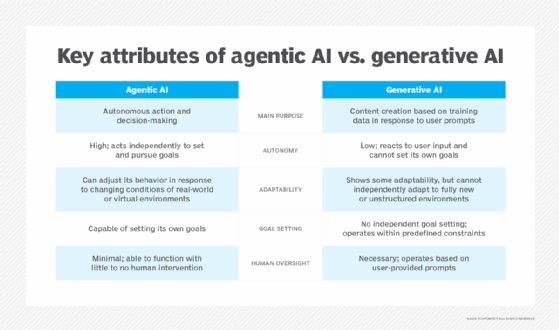
Agentic and generative AI differ in autonomy and behavior, but both appear in this article as capabilities embedded inside existing enterprise tools, shaping how work gets done before anyone frames them as an adoption decision.
Governance shows up as part of the work, not a blocker
The governance concerns are real. UC systems move sensitive information, and some of that data falls under regulatory or privacy requirements. But this isn't new territory for most organizations.
Rather than slowing things down, governance here looks like applying the same standards companies already use for other enterprise systems. Policies, controls, and oversight follow the capability rather than stopping it.
Ownership isn't abstract. It sits with the same mix of people who already deal with risk and compliance -- legal teams, IT leaders and the groups responsible for deploying the tools. The fact that governance is discussed at all signals something important: it is assumed it will stick around.
When AI disappears into the workflow
At Salesforce, agentic AI is now built into daily work to the point where people don't really think about it as AI anymore. Sales teams interact with it through Slack channels. They ask questions and get answers. That's the experience.
It doesn't matter to the person asking whether the answer comes from a human or from an agent. That distinction isn't considered. The novelty phase is long past.
AI takes on small, previously human tasks -- scheduling, research, follow-ups -- and removes friction quietly. The result isn't fewer people doing less work. It's more work getting done, with people spending their time elsewhere.
There's no clear moment where someone decided to "adopt AI." It's already there -- it's just how the work happens now.
What stands out across these examples isn't a bold pivot or a clean adoption story. It's how quickly the question of whether to use AI fades into the background.
Once a capability proves useful, it stops feeling like a decision at all. It becomes part of how discovery works, how communication flows, how work gets done. By the time anyone thinks about debating it, the behavior has already moved on.
That's where this kind of change tends to settle -- not in plans or proclamations, but in habit.
James Alan Miller is a veteran technology editor and writer who leads Informa TechTarget's Enterprise Software group. He oversees coverage of ERP & Supply Chain, HR Software, Customer Experience, Communications & Collaboration and End-User Computing topics.