
Getty Images/iStockphoto
Salesforce productizes its own customer service AI agent for users
Salesforce also becomes the latest CX tech vendor to try its hand at outcomes-based pricing.

Evolving its customer service AI offering, Salesforce plans to release Agentforce Help Agent next month.
Help Agent commingles training on a user's own Agentforce Service (formerly Service Cloud) data with learnings from Salesforce's customer service agent that powers Help.Salesforce.com. It has conducted more than 4.5 million conversations since its launch in October 2024; Salesforce claims its AI agent autonomously solves roughly two-thirds of customer issues at its help site.
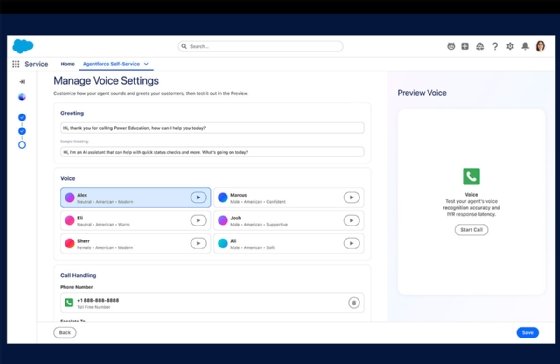
The agent comes with prepackaged actions and case management. It enables agent communications across numerous channels, all accessible from a single dashboard, including voice, web and text messaging. Another channel is an updated Agentforce Customer Service portal that personalizes experiences to customers' questions.
Agentforce Help Agent also includes a testing tool that previews how the agent will answer queries.
As Salesforce built out Agentforce during the last two years, the company gathered intelligence on what makes a more straightforward agent deployment through its own rollouts and those at customer sites. The upshot? Rather than prescriptively telling customers how to launch agents, Salesforce needed to simplify implementations by giving them prepackaged, ready-to-use agents, said Rebecca Wettemann, founder of Valoir, an independent research firm.
"This is about enabling customers to get up and running more quickly," Wettemann said. "Salesforce has done the heavy lifting for [users] on things like when to use declarative workflow versus LLM calls."
While Agentforce Service customers are interested in Agentforce, they are still in the exploratory stages. One of them, PenFed Credit Union, has focused on automating specific workflows to enable agents to retrieve customer data faster than humans can look it up -- also streamlining documentation processes for loan applicants and officers.
At this point, PenFed's agents are mostly being tested and used by employees, and they're focused on aggregating information more than taking action autonomously, said Nicole LaCamp, senior vice president of platform strategy and engineering at the credit union.
The ultimate goal is to incorporate agents in its next generation of “cognitive banking," a broader banking trend in which apps dashboard personalizes financial data for the customer and makes recommendations on possible next actions.
LaCamp believes that LLMs will eventually help customers consolidate the data across disparate systems and uncover trends such as duplicate transactions or subscriptions and other helpful personal-finance analysis that they can only do manually now.
"In terms of being able to take a lot of unstructured data, look at it differently, and provide more proactive information -- that's where I think generative AI sits in that cognitive banking journey," LaCamp said.
New pricing to come
Salesforce joins fellow SaaS CX vendors, including Pegasystems, HubSpot and Zendesk, in adopting outcomes-based pricing, which charges users when AI resolves a customer case. They will go into effect next month, along with the release of Agentforce Help Agent. Salesforce also acquired Fin earlier this month, which includes features and analytics that Salesforce plans to integrate into future iterations of Agentforce Service once the deal closes.
Salesforce calls its pricing model "pay-per-resolution," which doesn't meter customer interactions with AI agents if a conversation is abandoned, escalated to a human, or the customer gives negative feedback.
Kishan Chetan, executive vice president and general manager of Agentforce Service, points out that Salesforce can measure outcomes because it has insight into both the human and AI sides of conversations. Customers had been asking for pricing tied to business metrics rather than to the consumption of AI credits or tokens.
But there's always a learning curve to new pricing models.
"The whole thing is predicated on the fact that you can essentially answer more questions than you ever did before to the customer's satisfaction," Chetan said. "Conceptually -- and from a business goals perspective -- everybody gets it. They know that doing more resolutions drives customer satisfaction. So as long as we explain very clearly what constitutes a 'resolution'…they get it."
His colleague, Prasad Raje, senior vice president of product management for Agentforce Service, said that Salesforce's service-oriented customer advisory board influenced the pricing model.
"We are aligned with our customers' business goals," Raje said. "If there is no need for a human escalation, that's a clear signal that the agent has done the job. If there is a need for human escalation, that means our customer is going to expend the cost of the human handling that call -- and we don't get paid."
Don Fluckinger is a seasoned B2B technology journalist with more than 30 years of experience specializing in enterprise IT, digital experience and content management. As a senior news writer at Informa TechTarget, he delivers award-winning analysis that helps IT and business leaders navigate complex technologies to enhance customer and employee experiences. Got a tip? Email him.
Dig Deeper on Customer Experience
-
![]()
Customer service AI pricing just turned into the biggest shell game
By: Don Fluckinger
-
![]()
Agentforce Operations tackles workflow orchestration
By: Don Fluckinger
-
![]()
Salesforce releases Agentforce dev tools, updates Agent Fabric
By: Don Fluckinger
-
![]()
Salesforce adds Agentforce agentic AI to SMB packages
By: Don Fluckinger